Monday

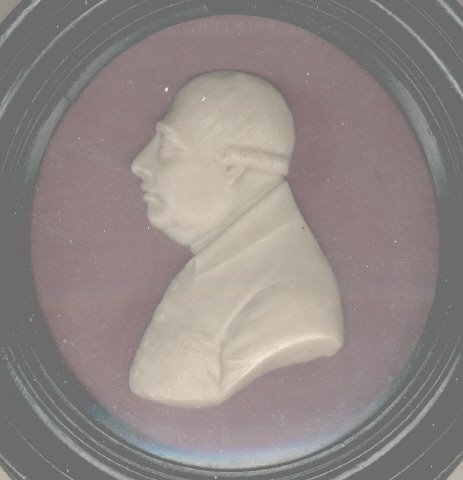
Andras, Catherine - portrait of King George III


This miniature portrait is in wax and is signed below the bust "C Andras A D 1820". Catherine Andras (1775-1860) was a wax modeller who worked in London. This wax model of George III is recorded in Pyke's Dictionary. On the rear of the frame there is a typed note recording "Inside the back of this frame is the origimal receipt made out as follows :- Portrait of / His Late Majesty George the Third/ Modelled by Catherine Andras / Modeller in Wax to His Late Majesty / Published (?) as his aide directed July 4th 1821 / No. 30 Pall Mall / 2 Guineas". 1093

Friday

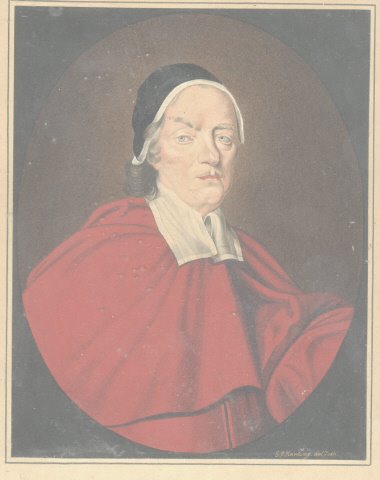
Harding, George - portrait of John Maynard


This miniature portrait is signed "G P Harding del 1811" for George Perfect Harding" (1780-1853). The portrait is inscribed "To John Maynard Kt". This appears to be a copy of the portrait of Sir John Maynard (1602-1690) by John Riley (1646-1691) that hangs in the NPG London. 175

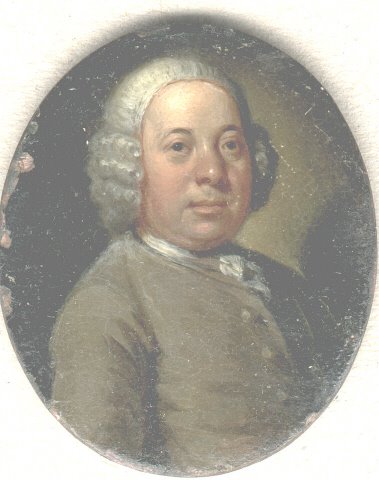
Unknown - portrait of a man


This unsigned miniature portrait is oil on copper. Although included under British, it may be European. 328

A kind visitor has since left a comment wondering if it is by Cornelius Troost (1697-1750). Troost has been called "the Hogarth Hollandais" and the Watteau Hollandais", and of him the following has been written;
Cornelis Troost, the son of a goldsmith, first chose a profession as an actor, performing at the Amsterdam Theatre, c. 1717-24. His wife's family were theatre people, while his own family were artists. One of Troost's earliest works was his infamous drawing of 'Prince Eugene of Savoy in the brothel of Madame Teresa on Prinsengracht.' The prince was Austrian governor of the The Netherlands at the time. (‘Prins Eugenius van Savoye in het etablissement van Madame Traese op de Prinsengracht te Amsterdam,' Cornelis Troost (ca. 1720) Rijksmuseum, Amsterdam.)


Beginning in 1723 Troost studied under the eminent portrait painter, Arnold Boonen (1669-1729) and was, himself, initially predominately a portraitist. Finding quick success, by 1724, he received a commission for a life-size group portrait of 'The Inspectors of Collegium Medicum,' now in the Rijksmuseum, Amsterdam. The success of this work led to many other large works, though few survive intact. (Ref. 'Dutch Painting, 1600-1800,' Prof. Seymour Slive, The Yale University Press)


Troost never abandoned his thespian connections. From 1732, he produced a number of acclaimed depictions of theatrical scenes, as well as painting a number of stage sets for his old theatre, though none of the latter are known to survive. (Ref. J.W. Niemeijer, Cornelis Troost 1696-1750, Assen, 1973.) His study for Molière's 'Le Malade Imaginaire' was auctioned by Christie's in 2004, bringing £43,020 ($78,985).


Troost was also lauded for his conversation pieces and genre scenes. His best known work, his 'NELRI' series (1739-40), exhibited at Mauritshuis, The Hague, portrays a group of young bachelors at a reunion, beginning with a quiet evening, eventually ending with a scene long after midnight, in which the young men are all very drunk: a humorous work skillfully showing the emotional and physiological stages of inebriation. Sometimes Troost is referred to as the Dutch Hogarth, though his work never moralizes, emphasizing instead the humor of situations.


Fuchs describes Troost as "by far the most original and versatile artist of his age" (Fuchs, RH, 'Dutch painting,' 1978, Thames and Hudson, London, p. 144). A luscious self portrait by Troost may be seen by Googling 'Troost Self Rijksmuseum.' While there, take a look at his other works at that museum. Others may be seen in The Royal Picture Gallery at the Mauritshuis in Den Haag. 

Examples of miniatures by Troost appear to be uncommon, although he is listed in Blattel.

Thursday

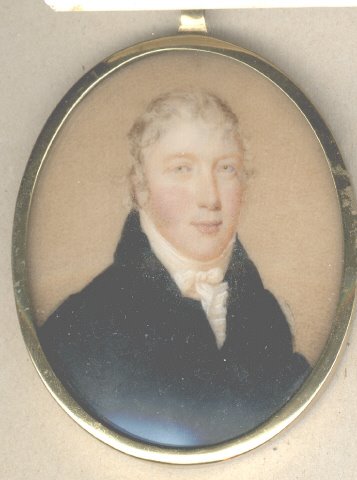
Donaldson, John - portrait of William Pitt the Younger

Although unsigned, this miniature portrait has been attributed to John Donaldson (1737-1801), a Scottish artist who also worked in London.

One of the bracelet clips at the rear is engraved "Rt Hon'ble William Pitt" for William Pitt (28 May 1759 – 23 January 1806) the famous British Prime Minister of the late 18C. He was the son of William Pitt the Elder (1708-1778), who was Prime Minister of Great Britain (1766-1768).

William Pitt the Younger became the youngest ever Prime Minister of Great Britain between (1783-1801) and again between (1804-1806).

It appears from the clothing and wig style that Donaldson painted the portrait in the mid 1780's and has slightly emphasized Pitt's youth, as he has given him softer features than the 1787 Gainsborough portrait of Pitt.


Comparison can be made with three other large oil portraits of William Pitt the Younger, all painted around the period 1785-1790 which are illustrated here. The one on the right, painted by Thomas Gainsborough c1787, appears in William Hague's biography of William Pitt.

Thus the miniature was probably painted in 1784 or 1785, shortly after the time Pitt became Prime Minister in 1783.

Pitt never married and it seems possible that the miniature was painted at the request on his mother, who must have hoped he would marry.

In 1783 he was reputedly offered as a wife, the seventeen year old daughter of the fabulously rich French politician Jacques Necker, and much later in 1796 there was some expectation that he would marry Lady Eleanor Eden, the attractive daughter of Lord Eden.

The miniature is believed to be genuine, although it is difficult to be 100% sure. However, it should theoretically be possible to confirm or disprove the identity of William Pitt as the sitter, by taking a DNA sample from the lock of hair contained in the reverse of the locket.

The locket case with the hair back is similar to, but less elaborate than one of similar date on page 325 of Foskett. The engraved bracelet clips on this miniature appear to have been added slightly later. This was not uncommon and there are various miniatures in this collection that had bracelet clips or brooch pins added after the date of the original miniature.

For much more about William Pitt, see William Pitt the Younger - Wikipedia, the free encyclopedia

For a second miniature of William Pitt in this collection see View 1135

Wednesday

Thomson, William J - portrait of John Gloag


This miniature is signed and dated 1814 on the reverse. The artist is William John Thomson (1771-1845). He was born in Savannah in the United States, but for much of life he worked in Edinburgh, Scotland. The sitter is identified as John Gloag. 931

Unknown - portrait of Sir Walter Scott


This miniature portrait is by an unknown artist, but the sitter is Sir Walter Scott, the famous Scottish author. 985

Tuesday

Stevenson, William - portrait of Seth William Stevenson

The painter of this miniature portrait is not known for sure. However, if the sitter is aged 36 or less in the miniature, and with the help of a kind visitor as noted further below, it is most likely painted by his father, William Stevenson. Thus for the purpose of this description, he is considered to be aged 36!

It it is inscribed on the reverse "celebrated numismatologist. Stevenson, Norwich. Father of Adelaide who married John Deighton of Cambridge." Thus the sitter is identified as Seth William Stevenson (1785 – 1853) who wrote a 929 page book entitled "Dictionary of Roman Coins". This was published in 1889 after his death and remained in print for about another 100 years.

In the 1851 census, Seth William Stevenson was a widower, his wife being Mary (1801- <1851). He was then aged 63 and is recorded as the co-proprietor and editor of the Norfolk Chronicle weekly journal. In 1851 he lived at 173 Surrey Street Norwich, along with his daughter Adelaide, then aged 21 and his son Henry aged 18 who later assisted completion of the book after his father's death. 1061.

A kind visitor has provided the following extra information;
"Did you know that Seth William Stevenson’s father was a miniature painter ? Apparently he trained at the Royal Academy and was a pupil of Rubens. William Stevenson lived from 1749 to 1821 He was also a publisher and author and Sheriff of Norwich in 1799. He was Co-proprietor of the Norfolk Chronicle. There is a substantial monumental inscription to William and his wife in St Stephen’s church in Norwich.

His son Seth William Stevenson (1785 – 1853) succeeded his father as proprietor and virtual editor of the Chronicle. He also served in the office of Sheriff of Norwich in 1828, and as Mayor in 1832.

Upon Seth’s death his son Henry Stevenson (1832/3) succeeded him as Proprietor of the Chronicle and served as Sheriff of Norwich in 1875. He retired before his death in 1888 and died a chronic alcoholic. Henry Stevenson was widowed from his first wife and then married my great aunt, Ann Emilia Self.

In family documents there are references to the Stevenson family silver, much of which is owned by descendants within my family in New Zealand. By all accounts they were wealthy. My great grandmother also writes of ‘exquisite miniatures, & family portraits’ in the Stevenson estate."

Dixon, Annie - portrait of a youg girl


This miniature portrait is inscribed on the reverse, "by Miss Dixon Horncastle and No. 5 Fitz Roy House(?), Fitz Roy Square". The name of the sitter is also shown, but unfortunately a previous owner has crossed this out so it is illegible. This probably happened when it was sold out of the family. 302

Dixon, Annie - portrait of young girl


This miniature portrait is signed on the reverse, "Portrait painted by Miss A Dixon, Horncastle". This is for Annie Dixon (1817-1901). The sitter is unknown. 303

Macleay, Kenneth - portrait of a lady


This miniature portrait is signed 'K MLeay 1834" for Kenneth Macleay (1802 -1878) . The sitter is unidentified. 301

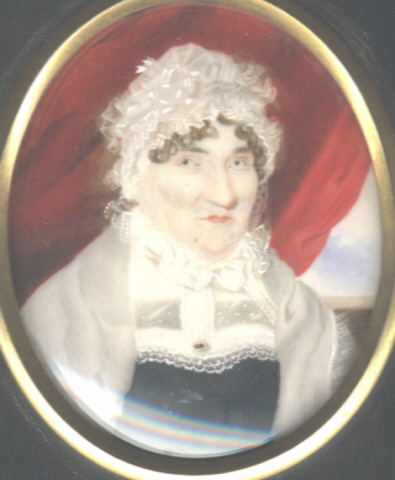
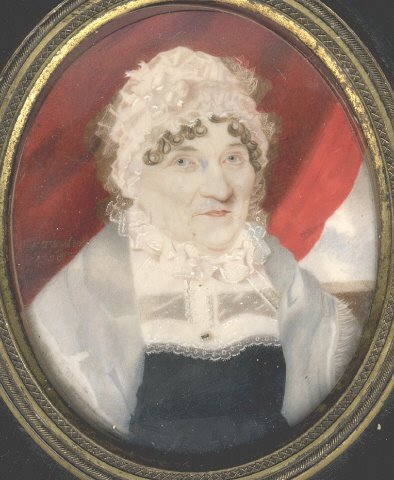
Tayler, Charles Foot - portrait of old lady


Both these miniature portraits are signed "C F Tayler 1820" for Charles Foot Tayler (1800 - 1853). He came from the Isle of Wight, but painted in Bath for many years. The portraits are interesting, as they would have been painted at the same time, but for different members of the sitter's family. One came from California and one from Kent, England, so it was nice to reunite them.

The sitter is unknown, but one of them has an inscription on the rear "Princess of Stacia. Painted by C F Taylor 1820". However, this name has not yet been traced. 1106, 1187

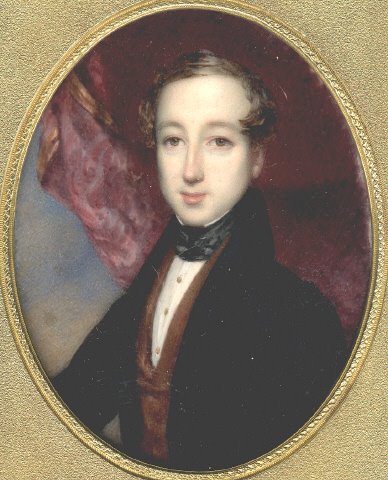
Tayler, Charles Foot - portrait of a young man


This miniature portrait is signed "C F Tayler 1821" for Charles Foot Tayler (1800-1853). The sitter is unknown. 24

Durham, Cornelius Bevis - portrait of a young man


This miniature portrait is signed by Cornelius Bevis Durham (7 Jun 1809-1884) and active (1825-1865). He was born in St Clements Dane, Middlesex and died in Christchurch, Hampshire in June 1884.

Durham can be tracked quite readily through the census records but a decline in his income due to competition from photography seems to become apparent. In 1841 he lives in Marylebone with his wife, Mary, three son, one also named Cornelius aged 4, the others being Edmund, 3 and Francis, 1 and there are also two female servants.

In 1851 he is an artist living in Marylebone with his first wife Mary, but only one son George aged 3 and one servant. However, he also seems to have various relatives or lodgers living with him, including a bazaar keeper and a newspaper seller.

In the 1861 and 1871 census records Durham describes himself as an artist and is now living near Brighton Pavilion in a large household, headed by his cousin Martha Phillips, who is a wealthy tea merchant. Mary his wife is there in 1861, but in 1871 he is a widower.

Durham can also be found in the 1881 census, but is now living in New Barnet with his son George and he gives his occupation as miniature painter. This is the only time he has used the occupation of miniature painter in the census records, all other times stating it as artist. He is then aged 71. His place of birth was St Clement Danes, Middlesex. He has remarried, this time to Mary Ann Upfill in 1872. He died in 1884.

The sitter is unknown. 87

Hamlet, T - portrait of a man


This miniature profile portrait is by T Hamlet. On the reverse there is most of his trade label. It is headed by the Royal Coat of Arms and under that reads;
"Hamlet, Miniature and Profile Painter to Her Majesty and the Royal Family, No 2 Old Bond Streeet Bath, takes the most striking likenesses on glass, paper, or ivory. A sitting of only one minute required. Large Shades reduced to any size. Profiles in Black from 2s 6d to L 1. 1s. Coloured from 10s 6d to L3. 3s. Prepared ivories for miniature painting and miniature Frames for sale. Ladies and Gentlemen waited on. Wood & Co. City Printing Office Bath."
The sitter is unknown. 295

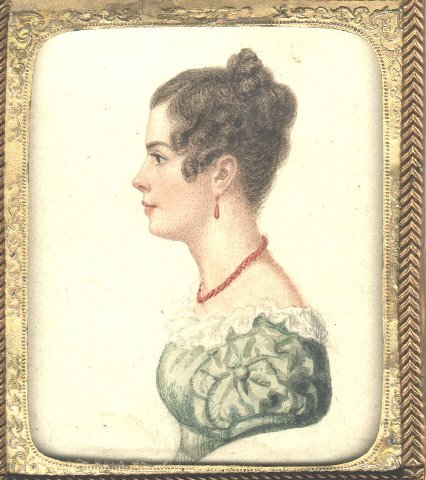
Hancock, Robert - portrait of a lady


This miniature profile portrait is inscribed on the reverse, "Painted 28th Sept 1824 by R Hancock - very like". This is probably the Robert Hancock who lived in Bristol. It seems likely that the unidentified sitter is a sister or other close relative of the adjacent portrait. 552

Hancock, Robert - portrait of a lady


This miniature profile portrait is inscribed on the reverse "Painted 29 Sept 1824. Very like". As the adjacent portrait is signed Robert Hancock in the same hand writing, this portrait must also be by him. The two sitters are most likely sisters, but their identities are unknown. 554

Unknown - portrait of a lady


The artist and sitter are unknown, but this miniature portrait may be by Richard Crosse. 139

Various - portraits of Kingsley family


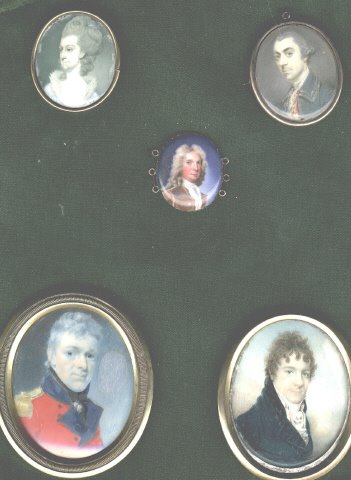
This group of miniature portraits are contained within a single frame. The sitters are all identified by very old notes inside the frame. The sitters include two ancestors of the famous writer Charles Kingsley who wrote "The Water Babies" and other books. Depicted are his father (bottom right) and his grandmother (top left). The other three images are believed to be related by marriage.

The man in the centre is James Wills and the following notes about him and his descendants are included in case they are of any interest to genealogists.

"James Wills who died 1731 married Martha Curtis and left 2 sons. (1) Godfrey, his heir - Lt Col Roscommon Militia (2) Robert of Annalee Co Carlow, and two daughters of whom one married Mr Lennox (?) a banker.

(Col) Godfrey Wills married (first) Sarah Montgomery of Ballinlongious (?) Co Monaghan - their children were (sons); (1) Thomas, his heir (2) Robert married Miss Dowely (?) (3) Caspar married Mr Carter's daughter. Daughters (1) Elizabeth married Thomas Mitchell of Castle Strange (?) Co Roscommon (2) Martha married Charles Wood of Larkfield Co Sligo (3) Sarah married Sir Ralph Fetherstone of Ardagh (4) Catherine married Ralph Owens (?) of Longford. (5) Susan married William Fetherstone of Carrick.

Col (Godfrey) Wills married secondly Charlotte Elizabeth, daughter of Luke Stirling of Mount Dutton Co Meath & had by her (4) (ie a fourth son) James Wills of Plas Bellin, who married Miss Kingsley. (5) Charles (6) Ann married William Berry of Eglish (?) Castle Kings Co.

Col Wills was succeeded by his eldest son, Thomas Wills of Willsgrove (?) who married in 1765 Jane Talbot - their children were (1) William Robert born 1779. (2) Sarah married Rev William McLoughlin (2) Elizabeth died unmarried (3) Ann married W D Burleigh, their son afterwards married the daughter of James Wills of Plas Bellin. (4) Jane died unmarried.

Godfrey the second of William & Susan Fetherstone, married in 1824 Matilda daughter of Rev Stephen Radcliff & his (her?) youngest sister Elizabeth married as her second husband, Rev Stephen Ratcliffe. Painewick (?) 30th July 1914.

The rear of the frame has a note saying "For my nephew Cecil Burleigh in New Zealand". 18

Unknown - portrait of James Wills

This unsigned miniature portrait is painted in enamel on copper. As it was painted around 1715-1725, the most likely artist was originally thought to be Christian Friederick Zincke (1683/4-1767), as there were very few painters in England painting enamel miniatures at this time. However, a kind and knowledgeable visitor to the website, advises it is not by Zincke, thus the artist is currently unknown.

The sitter is identified as "Jas Wills, grandfather of Jas Wills of Plas Bellin, died 1730". He is either the father or the grandfather of the James Wills in the portrait below which is signed Collins".
A marriage record has been found for him as James Wills (1675-1731) who married Martha Curtis of Dublin before 1723. In fact their marriage was probably closer to 1700, as their elder son Godfrey Wills married first, Sarah Montgomery on 6 Sep 1731. Godfrey Wills then married, second, Charlotte Elizabeth Stirling of Dublin on 6 Jun 1771. Godfrey and Sarah had a son called James Wills, who married Lucretia Ann Kingsley on 23 Nov 1801. Lucretia was the aunt of the author Charles Kinglsey.
There is a reference to a huge Elizabethan country house called Plas Bellin that is now a family refuge centre, see BBC - Beyond the Broadcast - Changing Places , but James Wills has not yet been confirmed as the owner in the 18C. 18a

Later June 2016
Further to my comment below, Tom, a very kind visitor has also sent me a chart of the relationship from James Wills to Christopher Plummer. Tom adds; As you can see, he is actually well connected - The Sarah Montgomery goes back to brother of the American Rev. War General. The Orme goes back to a minor titled family. The Swift - Christopher is 1st cousin 7 times removed to Jonathan Swift. And Isabella Abbott was grand-daughter of a Canadian Prime Minister. So the Wills family is in good company, one might say...

Collins, Samuel - portrait of James Wills


This miniature portrait is signed "Collins" for Samuel Collins (1735-1768). The sitter is identified on several notes within the overall frame, as James Wills. However, there are conflicts within the notes, as one describes him as the son of the James Wills who died in 1731 and another describes him as a grandson. Judging upon his age and costume, it would seem more likely he is a son of the earlier James Wills. The notes mentioning him read as follows.

"James Wills, son of above and father of Robert, Godfrey, Lucretia E (Burleigh) and Charlotte Wills. Died 1854 age 83."

"James Wills 2 married Lucretia Anne Kingsley, had issue Robert Wills, Godfrey Wills, Lucretia m W Burleigh, Charlotte. He died 1854 aged 83."

If he died on 1854 at age 83, he would have been born in 1771, but the artist Samuel Collins died in 1768 and the costume of the sitter is from around 1765. Thus it seems more likely that the sitter is a generation older than the notes suggest. It seems more likely that he is Godfrey Wills, the son of the James Wills who died in 1731 and the father of the younger James Wills. Godfrey Wills married second, Charlotte Elizabeth Stirling on 6 Jun 1771.

Another alternative that could fit the chronology associated with his age and costume, is that he is the Charles Kingsley (1743-1786) who married Elizabeth Ann Westney (1747-?), the sitter in the next portrait, on 24 Nov 1778. This would make him the grandfather of the author, Charles Kingsley. 18b

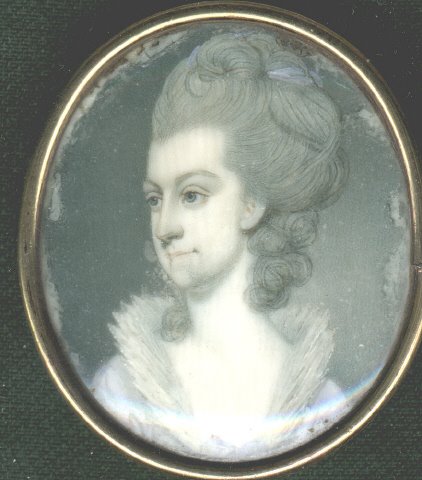
Crosse, Richard - portrait of Elizabeth Kingsley


This miniature portrait is unsigned, but it has been attributed to Richard Crosse (1742-1810). The sitter is identified by several notes inside the rear of the group frame.

"Elizabeth Westney, wife of Charles Kingsley Esq of Lymington, Hants, mother of the Rev C Kingsley of Chelsea and of Lucretia A Wills, wife of James Wills of Plus Bellin, Wales."

"Elizabeth Kingsley nee Westney married Charles Kinglsey of Lymington, mother of Rev C Kinglsey of Chelsea & Lucretia Ann Wills, wife of James Wills."

Her marriage record has been located for 24 Nov 1778, at St Anne Soho. Lomdon. Her son Charles Kingsley (1781-1860) was born on 23 Oct 1781. He was the father of the author Charles Kingsley, thus Elizabeth was the author's grandmother. 18c

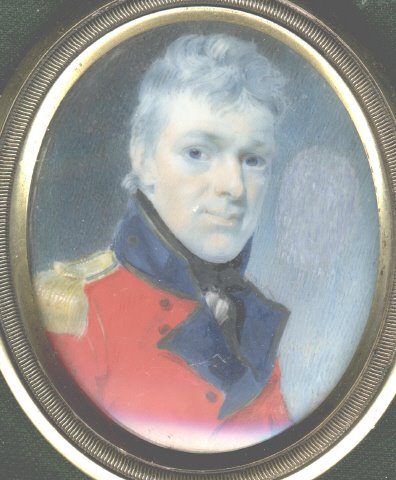
Unknown - portrait of Major Stirling


This miniature portrait is unsigned. The sitter is idneitfied on notes inside the group frame as Major Stirling.

"Major Stirling, uncle of James Mills of Plas Bellin."

"Major Stirling, uncle of James Wills (2) of Plas Bellin Northop Wales."

It seems that he must have been a brother of the Charlotte Elizabeth Stirling who married Godfrey Wills on 6 Jun 1771.

There was a Major Stirling with the 42nd Highland Regiment, the Black Watch, who acted heroically in Egypt during the Nile Campaign, but it is not known if this is the same Major Stirling. 18d

Unknown - portrait of Rev Charles Kingsley


This miniature portrait is unsigned. The sitter is identified by notes inside the group frame as Rev Charles Kingsley.

"Rev C Kingsley of Bottomsby (?) and Chelsea. Brother of Lucretia A Wills and father of Rev C Kingsley, of George and Henry and George Kingsley."

"Rev Charles Kingsley of Chelsea, father of Canon Charles Kingsley, rector of Eversley and brother of Lucretia A Wills (nee Kinglsey) - uncle of Robert, Godfrey, Lucretia and Charlotte Wills. Lucretia E Wills married William Burleigh of St Catherines Carrickfergus."

The Rev Charles Kingsley (1781-1860) married Mary Lucas (1782-1873) in 1808 at Christchurch Parish in Barbados. They had five sons and a daughter. The author Charles Kingsley (1819-1875) was the eldest of their sons. For more about him see Charles Kingsley 18e

Unknown - portrait of a lady


Although neither the artist who painted this miniature portrait, nor the sitter are known, it is of very high quality for a profile portrait. On the reverse of the frame the date 1824 has been scratched and that seems a likely date. It is most probably British, but could possibly be American. 598

Uwins, Thomas - portrait of Lady Collins


This miniature portrait is by Thomas Uwins (1782-1857). On the reverse is is inscribed "Lady Collins. Painted by Thos Uwins Oct 1816". 341

Thompson, Thomas - portrait of a man


This miniature portrait is signed with the initials "T T ", and it has been attributed to Thomas Clement Thompson (1778-1857). The initials of the sitter "R A C" are on the reverse in gold filigree. 400

Buck, Frederick - portrait of a man

Although this miniature is unsigned, it appears to be painted in the distinctive style of Frederick Buck (1771-1840) of, Cork, Ireland.

Daphne Foskett comments; "During the Peninuslar War, when Cork was a busy port of embarkation, his services were in great demand to paint portraits of officers. In order to keep pace with demand, he kept a supply of painted ivories to which he added the heads and regimental facings as required."

and "His work is not as good as his brother Adam Buck and the features are often badly drawn and modelled; he used a rather hot colouring which looks hard and reflects the haste with which he so often painted. He sometimes painted cloudy sky backgrounds on the reverse of the ivory which he left blank on the front."

The design of the reverse of the case, is often found on Irish miniatures and this form of case design made its way across the Atlantic with Irish artists who emigrated to the United States.

However, a kind visitor has also suggested that another potential artist for the miniature may instead be by Henry Kirchhoffer (1781-1860) who was also from Ireland and painted in a somewhat similar style, although he was a little more original than the "cookie-cutter" style of Frederick Buck.

In the meantime, both names are offered for any further comment.

The reverse has the initials of the sitter "E J" in filigree gold, but otherwise the sitter is unknown. 644

Watling, Thomas - portrait of a man


Comparison of this miniature by Thomas Watling can be made with a recent record sale for a work by this artist, referred to below.

The Watling miniature in this collection is shown here in front and rear views. Also shown much enlarged is the signature "T W", which is faint as it was difficult to scan through the glass. The "T" and "W" are formed in the same manner as the example from the miniature of John White, and as if by an engraver, which was Watling's profession. However, it is conceded the initials may be meant to be "J W" or "I W".

In Foskett, there are no other obvious contenders with the initials "T W" and working around 1795-1805, which appears to be the date of this case. Foskett observes that Watling was working in Calcutta in 1803, and this was presumably after being released in Australia.

More recent research notes that he returned to Britain in 1804 and presumably continued painting there. Given the ornate frame, it seems possible this second miniature dates from after his return to Britain.

There is a small booklet about Thomas Watling which was produced to accompany a 1988 exhibition about him and his work in Dumfries, Scotland.

When acquired, this miniature was attributed to Thomas Watling and the sitter was said to be related to the Macquarie family who were early settlers in Australia. The rear does include initials which appear to read "M F". However, to date, no research has been undertaken to try and find an early Australian settler with the intitials "M F", but it seems a little unlikely that the sitter has an Australian connection.

However, if any researcher familiar with early Australian history, can suggest a suitable name, I would be very grateful. Of course, one obvious Australian explorer with the initials "M F", is the navigator and cartographer Matthew Flinders (1774-1814), but this sitter looks to be too old to be Flinders.

It can be compared with one interesting miniature sold in late 2007 by Gorringes. A big surprise, it was this unframed miniature by the Australian convict and artist Thomas Watling (1762->1806). It was signed and dated 1792, the year Watling finally reached the colony in Australia, after being sentenced to 14 years for forging banknotes in Dumfries.

The miniature depicts John White, the chief surgeon for the First Fleet, the 11 ships that sailed to Botany Bay in 1786 to establish a convict settlement in Australia.

After his arrival, Watling made many drawings which form the basis of the important studies of wildlife, landscapes, and the indigenous people of Australia known as the Watling Collection, now housed in the zoological library of the Natural History Museum in London. He was pardoned in April 1797, see Watling, Thomas (1762 - ) Biographical Entry - Australian ...

The miniature was offered for sale by Gorringes in Sussex, England on 6 December 2007, seeking an opening bid of GBP120 and with an estimate of GBP200/400. I was tempted to leave an absentee bid of GBP550, well over the estimate to have a good chance of winning, but in the event did not bid.

To the astonishment of everyone, me included, but excepting the two bidders concerned, there were 405 bids according to the eBay auction record, which took the hammer price to GBP90,000, say $210,000 including buyer's commission.

To the best of my knowledge, this is a record price for any miniature sold at a combined live/eBay auction.

In reporting on the sale Antiques Trade Gazette - News & Analysis comments; "On his arrival, he was very quickly assigned to John White. White had become Surgeon General of New South Wales and, as an ardent naturalist who was collecting and documenting specimens, he made use of Watling�s artistic talents. Over the next two years Watling made many drawings which form the basis of the important studies of wildlife, landscapes, and the indigenous people of Australia known as the Watling Collection, now housed in the zoological library of the Natural History Museum in London. Indeed, many of the drawings are annotated in John White's hand. John White does have a connection to East Sussex since, after he returned to England, he spent his last years living in Brighton and died at Worthing in 1832."

Also "Watling's only major known surviving work is Sydney in 1794, a large oil painting which hangs in the Dixson Gallery, Sydney. There are some sketches and finished drawings, a few of which have appeared on the market, but the discovery of this miniature appears to be something of a first."

However, as there are now two miniatures by Thomas Watling, it suggests there are more waiting to be found. 340

Fischer, Johann Georg Paul - portrait of a man


This miniature portrait is signed "J P F" for Johann Georg Paul Fischer (1786 - 1875). He did sign in several different ways and the adjacent portrait by him is signed Paul Fischer. The sitter is unknown. 822

Fischer, Johann Georg Paul - portrait of a man


This miniature portrait is signed on the reverse "Paul Fischer" for Johann Georg Paul Fischer (1786-1875). The sitter is unknown. 373

Bogle, John - portrait of a man


Although this miniature portrait is unsigned, it has been attributed to John Bogle (1746-1803). The sitter is unknown. 640

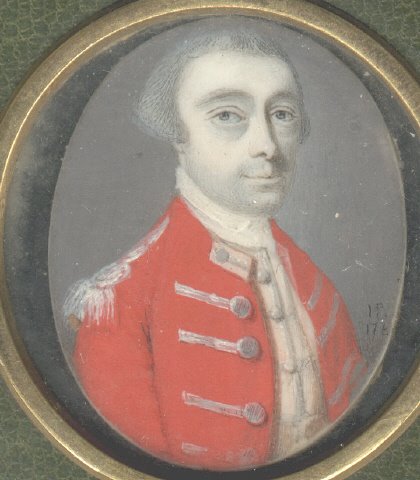
Redmond, Thomas - portrait of Major French


This miniature portrait is signed "I R (or T R) 176?). It has been attributed to Thomas Redmond (c 1745- 1785). It is inscribed on the reverse "Major French who married Mrs Donnellan. Drowned coming from Margate". It seems likely that he is either the same person, or perhaps more likely is closely related to the sitter in the adjacent portrait. At french1 there are references to two brothers, both called John French. They both seem to have died in 1775 and one of them married Frances Donellan in 1775. 305

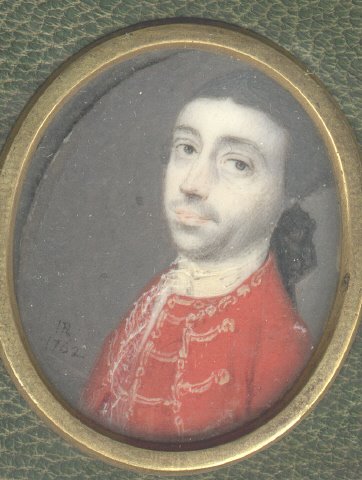
Redmond, Thomas - portrait of John French


This miniature portrait is signed either (I R (or T R) 1762". It has been attributed to Thomas Redmond (c1745-1785). The reverse of the portrait is inscribed "John French who was to have been Lord Dungar. Drowned coming from Margate". It seems likely he is either the same person, or perhaps more likely a close relative of the sitter in the adjacent portrait. At french1 there is a reference to two brothers, both of whom appear to have been called John French and both seem to have died in 1775. One of them married Frances Donellan in 1775. 306

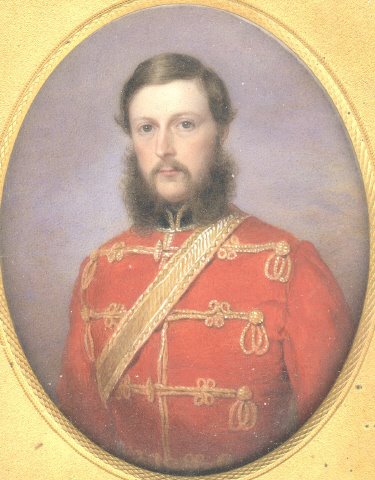
Unknown - portrait of a Victorian soldier


Although neither the artist nor the sitter are known, this miniature portrait of a Victorian soldier is extremely well painted. 128

Monday

Unknown - portrait of The Hon Augustus Henry Archibald Anson VC

This miniature portrait on ivory was acquired in 2001 and has sat since posted on this site in 2006, as unsigned, with the sitter unidentified.

It is rare to be able to identify a sitter, but now in late October 2007, almost exactly 150 years to the day since he earned the Victoria Cross, it has been possible to identity the sitter from his clothing, i.e. his uniform and two medals, the Victoria Cross and the Indian Mutiny Medal.

Research has determined that the sitter is the Hon. Augustus Henry Archibald Anson VC (5 Mar 1835-17 Dec 1877), a son of the Earl of Lichfield. In 1863 when he was aged 28, he married Amelia Maria Claughton (4 Jun 1843-4 Jan 1894). Amelia was the daughter of the future Bishop of St Albans, the Right Rev. Thomas Leigh Claughton. They seem not to have had any children.

It is likely the two colours of woven hair on the reverse side of the miniature are those of Anson and of Amelia. Possibly this hair could be used to confirm the sitter's identity using DNA analysis.

Anson's father the Earl of Lichfield was Postmaster-General from May 1835 to Sep 1841 and during his administration the universal penny-postage system was brought into operation. This featured the first ever postage stamp, the Penny Black, and was championed by Sir Rowland Hill. For more see Penny Black - Wikipedia, the free encyclopedia

However, when Augustus was only seven years old in 1842, the Earl of Lichfield fell into serious pecuniary difficulties. His magnificent mansion in St James Square was dismantled and its contents dispersed by the hammer of Mr George Robins, as were those also of his country seat at Shugborough where the same official held a sale for twelve days. The Earl had earlier been a "warm supporter of the turf" and in 1836 his horse Elis won the St Ledger.

The logic behind the attribution of the miniature is as follows. The sitter is an army officer wearing both the Victoria Cross and the Indian Mutiny medal. His rank badges appear to be those of a Lieutenant-Colonel. His age in the portrait could well be 28 and thus fit with this being a miniature painted at the time of his marriage in 1863.

The miniature must be one of the very early, if not the earliest, contemporary painted portrait of a winner of the Victoria Cross wearing his medal. As such it is of considerable rarity, although obviously not in the class of a Victoria Cross medal itself, as they usually sell for an average of around GBP150,000.

The Victoria Cross was created in 1856 and the first Victoria Cross investiture was carried out in June 1857, when 62 winners were invested. The Indian Mutiny medal is also shown here, with this example having the Lucknow clasp.

A kind visitor has pointed out that Anson won three clasps, although only one is shown in the miniature. This was probably artistic licence, to enable the colour of the ribbon to still be seen. For much more about the Victoria Cross, see; The History of the Victoria Cross, The Victoria Cross Society for enthusiasts , and Victoria Cross Research - research@victoriacross.co.uk - Designed ...


A total of 182 Victoria Crosses were awarded during the Indian Mutiny and the recipients are recorded along with other Victoria Cross winners in the book "The Register of the Victoria Cross" published in 1997.

In almost all cases, pictures of the winners of the VC are included in the book. By a process of elimination, the 182 winners in the Indian Mutiny were reduced to about 50 recipients who had a VC won in the Indian Mutiny and who subsequently achieved an army rank of Lieutenant-Colonel or higher during their career. However, of the 50, there were only three or four whose highest rank achieved during their military career was Lieutenant-Colonel.

While this does not make it certain it was the highest rank this sitter achieved, it does make it more likely. Additionally, the book contains the photograph shown below of Hon Augustus Henry Archibald Anson, which is remarkably similar to the miniature, although he appears a little older. Anson died in France in 1877 when he was only 42. The cause of death is unknown, but being in France and at such an early age, one might suspect it was possibly at a tuberculosis sanatorium?

Anson seems to have entered the army as an ensign in 1853 in the 44th Foot via purchase of the rank. He served in the Crimea 1854-56 and also in China 1857-1860. Being from a wealthy family he would not have needed to pursue an army career for his whole life and when he retired, he had achieved the rank of Lieutenant-Colonel in the 84th Regiment (later the York and Lancaster Regiment). He appears to have resigned his commission around the time of his marriage, possibly due to ill health. He became MP for Bewdley from 1869-1874.

The citation for his VC is as follows; "On 28 September, 1857 at Bolandshahr, India, the 9th Light Dragoons had charged through the town and were reforming on the Serai, when the enemy tried to close the entrance by drawing their carts across it. Captain Anson, taking a lance, dashed out of the gateway and knocked the drivers off their carts. Owing to a wound in his left hand, he could not stop his horse and rode into the middle of the enemy who fired upon him. At Lucknow, on 16 November 1857 he again showed great gallantry when he entered with a storming party on the gates being burst open; his horse was killed and he was slightly wounded."

The date of 16 November, 1857 is significant as this is the day when the most ever awards of the Victoria Cross were made on one day, with 24 recipients. Thus Anson was one of these 24. His Victoria Cross is located at Shugborough estate, Milford, see Location of Augustus Anson's Victoria Cross

Contained within the National Portrait Gallery in London there is a large oil painting titled "The Relief of Lucknow, 1857" painted by Thomas Jones Barker in 1859. Purely for convenience, the central part of it is shown here, with more information being on the MOD website at www.army.mod.uk/.../the_indian_mutiny.htm

A number of those involved in the Relief of Lucknow and shown in the painting, are identified in the record of the painting as held by the NPG, including Major Hon A H Anson who by then had been promoted from Captain, see Major Hon. A. H. Anson

However, as the NPG does not show birth/death dates for Major Anson, nor does it refer to his award of the VC, it appears their research department has not yet made the connection. Two other VC winners in the painting also seem not to have not yet been identified by the NPG; Major Probyn (Sir Dighton MacNaughton Probyn (1833-1924) and Captain Watson (Sir John Watson (1829-1919) , see below.

Interestingly, a comparison of the names of the 29 men depicted in the painting, against the names of winners in the Register of the Victoria Cross, shows that only five of those depicted won the Victoria Cross during the campaign, despite 182 being awarded. Thus, the qualification for inclusion in the painting appears to be mainly birth, rather than gallantry.

The VC winners depicted in the painting and their affiliation are believed to be;

Hon Augustus Henry Archibald Anson (1835-1877) of the 84th Regiment
Thomas Henry Cavanagh (1821-1882) of the Bengal Civil Service
Sir William Peel (1824-1858), of the Royal Navy, although he won his VC in 1854 during the Crimean War
Sir Dighton MacNaughton Probyn (1833-1924) of the 2nd Punjab Cavalry
Frederick Sleigh Roberts, 1st Earl Roberts (1832-1914) of the Bengal Artillery
Sir John Watson (1829-1919) of the 1st Punjab Cavalry

One other VC winner not in the painting, but who may cause confusion is Sir Henry Marsham Havelock VC. The painting is said to include Sir Henry Havelock Bt (1795-1857) who died of dysentery at Lucknow on 24 November, a week after the Relief. However Sir Henry Marsham Havelock (1830-1897) won a VC at the Relief of Lucknow. Closer inspection of the painting should confirm it is the elder of the two who is actually depicted.

From the above analysis, it appears that Anson was the only infantry officer to both win a Victoria Cross, and be depicted in the painting, "The Relief of Lucknow".

For more about Anson, see Augustus Anson - Wikipedia, the free encyclopedia He is buried in France, see Augustus Henry Archibald Anson (1835 - 1877) - Find A Grave Memorial

Later - A very kind visitor has shared this miniature portrait and comment about; "Amelia Maria Claughton who married Anson in 1863 and, following his death, remarried in 1881 becoming the Duchess of Argyll. The attached image is a scan from a photograph of a miniature portrait of her. I can confirm that she did not have any children from either this or her subsequent marriage. The wedding veil she is wearing in the minature is Honiton lace."

How wonderful is the Internet, in enabling the reuniting of the portraits of husband and wife! The wedding seems more likely to be her first marriage. Thus it is possible some of Amelia's hair is inside the miniature. After the death of her husband in 1877, Amelia became on 13 Aug 1881, the second wife of the 8th Duke of Argyll. She died on 4 Jan 1894. 444

Later - A kind visitor has provided me with this newspaper reference:
"The Times - 22 Nov 1877

THE LATE COLONEL ANSON, V.C.

Our obituary contained yesterday the notice of the death, at Cannes [on the 17th], of Col. the Hon. A. Anson, V. C., formerly member for Lichfield and for Bewdley, aged 42. It is now five years since, in the full swing of his active, energetic, useful public life, he was struck down by that complaint from which few, if any, recover, and which in his case first showed itself in a rupture of a vessel in the lungs, the consequence of a long-neglected cold. But, though thus compelled to retire from Parliament and to lead the life of an invalid, spending each winter in the South of France, his active interest in current politics, especially in Army questions, never flagged, as his frequent letters in our columns showed; nor did he relax in his endeavours to obtain better terms for his brother officers, whose claims as regards compensation and promotion he had so perseveringly advocated in the House of Commons in the course of the debates on the abolition of Army purchase. It was when already seriously ill that he originated and drew up the form of the petition to Her Majesty in which the grievances and claims of the officers in the matter of purchase were set forth. This petition, after being extensively signed alike by purchase and non-purchase officers, was in due form submitted for presentation through the Field-Marshall Commanding-in-Chief. The result was the appointment of a Royal Commission to inquire into their complaints. It is, indeed, mainly due to the ability and determination shown by Colonel Anson in his conduct of this question that the claims of the officers have been recognized and dealt with in a liberal spirit. But it was not only in matters connected with the Army, but in many others, that he took an active part while a member of the House of Commons. He was one of the leading spirits of the "cave" which led to the fall of the Russell-Gladstone Administration. It is not, however, to Colonel Anson's career in Parliament, nor even to his successful conduct of the case of his brother officers, that we would chiefly call attention, but to his singularly gallant career in the profession of which, though so young in years when he retired from active service, he was so distinguished a member. He entered the Army shortly before the outbreak of the Crimean War, and from the time when, as a mere boy, he found himself in command of a party told off to occupy some rifle-pits before Sebastopol, on which occasion nearly every man under him was killed or wounded, until he returned to England after the capture of Peking and the burning of the Summer Palace, he was on all occasions, whether in the Crimea, in India, or in China, distinguished by his coolness, judgment, and gallantry in the field. After the Crimean War he was appointed aide-de-camp to his uncle, General Anson, commanding-in-chief in India, on whose death, at the outbreak of the Indian Mutiny, he was attached to the 9th Lancers and to the Staff of Sir Hope Grant, serving as his aide-de-camp with great distinction through the whole of the Indian campaign, from the siege and storming of Delhi to the last shot on the borders of Nepaul. For these services he received a Brevet Majority. For acts of personal valour he received the Victoria Cross. It was accorded to him on the 24th of December, 1858, and his conduct was thus recorded in the Gazette:---
"Dates of acts of bravery --- 28th of September, and 16th of November, 1857. For conspicuous bravery at Bolundehaher, on the 28th of September, 1857. The 9th Light Dragoons had charged through the town and were reforming in the Serai. The enemy attempted to close the entrance by drawing their carts across it, so as to shut in the Cavalry and form a cover from which to fire upon them. Captain Anson, taking a lance, dashed out of the gateway and knocked the drivers off their carts. Owing to a wound in his left hand, received at Delhi, he could not stop his horse, and rode into the middle of the enemy, who fired a volley at him, one ball passing through his coat. At Lucknow, at the assault of the Secundra Bagh, on the 16th of November, 1857, he entered with the storming party on the gates being burst open. He had his horse killed, and was himself slightly wounded. He has shown the greatest gallantry on every occasion, and has slain many enemies in fight." (Despatch from Major-General Sir Grant Hope, K.C.B., dated the 12th of August, 1858.)
India, however, was not to be the close of his distinguished career in the field. When the China Expedition was organized under Sir Hope Grant he again accompanied his old chief as aide-de-camp, and was among the first, if not the very first, to force his way, sword in hand, into the Taku fort. On the taking of Pekin he was sent home with the despatches, and was offered, as a reward for his services, the choice of a Brevet Lieutenany-Colonelcy or an unattached substantive Majority. Unluckily for himself he chose the latter, the result being that he found himself shelved and shut out from further service, having failed to obtain permission to change back into a regiment after repeated application. Thus it was that he took to Parliamentary life; otherwise there is little doubt his name would have again been heard of, as he would eagerly have sought fresh distinctions in future campaigns. Especially would he have been anxious to offer his services to his old friend and fellow campaigner, Sir Garnet Wolseley. But although the services in the field of a most efficient and gallant soldier were thus practically lost to the country, his brother officers, as we have shown, have had no cause to regret the decision of the military authorities which put an end to his military career and led him into Parliament. It only remains to note that he was from the first a warm supporter of the Volunteer Force. Of this he became an active member, accepting a Majority in the London Scottish, of which Sir Hope Grant was at that time the Honorary Colonel, and he continued to serve in this regiment until he was stricken down by illness.
We have thus drawn attention to the prominent incidents of Colonel Anson's military and public life, in the belief that many of our readers, besides his personal friends and fellow officers, take a deep interest in the distinguished career of this gallant soldier, whose true heart, noble spirit, patient courage in sickness, and well-earned hounour have left to others a bright example and added fresh lustre to a well-known name."